The Great Make and Cake Tangent at TWIHM

20 June 2014

Let there be cake! To accompany the craft of course...
The title is a bit of a giveaway. Yep, I'm going off piste here at TWIHM for a few posts and writing about a topic dear to the hearts of many a crafter, nay, many a human blessed / afflicted (delete where applicable) with a sweet tooth:

CAKE.

The story begins a few weeks ago when I unpacked a box of Ladybird books for the Cherub. A box that had been sitting in the familial attic for a couple of decades since I was of more cherubic maturity and stature myself. Amongst the literary delights of On the Farm and Bunnikins has a Party was this gem of a cook book.

Making and Decorating Cakes.

Ooooh, the nostalgia. Look at these baked beauties. All of the recipes seem to involve margerine. The food styling is very much of its time, replete with geometric kitchen tiles in dubious earthy hues.


So much piping. So much margerine. Lots of earthy-hued kitchen surfaces that mean you can't see the worst food stains.
However, amongst the baked delights the Cherub pointed to this little number:

As one friend pointed out, "At least it's a cake that looks like a cake rather than some sort of cartoon character or gravity defying architectural structure." Indeed.
And declared that this, and only this cake, this thing of beauty, would do for her pending birthday party.

"Oh crumbs" I thought (aptly). "There's a lot of piping on there. I spy sugar-crafted flowers. And what on earth is Royal Icing? That sounds scarily grand."

Reading the instructions this cake demanded a couple of weeks of work from start to finish as each stage needed to sit before startins the next. A bit like knitting a cardigan really. But stickier. So the cake base itself had to mature a day or two before you could paste on the apricot jam and the marzipan layer. Leave it to settle and in a week or so's time it was ready for the application of Royal Icing and piping. Again, it needed to recover for a couple of days before placing the ribbon and finally serving.

As a home baker, I'm pretty au fait with cakes. Like many a woman of my generation I have Nigella's How to be a Domestic Goddess on the shelf. For the Australian version but with less corsetry, there is Donna Hay. I can make squidgy cakes, biscuits and slices that taste pretty good. We won't mention the lemon cheesecake that I may have added bicarb of soda to instead of cornflour and wondered why everything curdled.

But presentation is not really something that these tomes emphasise. It seems you can hide a multitude of aesthetic sins with a lavish sprinkle of icing sugar or smother the thing in chocolate sauce.

Job done. It's not a work of art. It's an edible indulgence that probably won't last the next half hour. Never mind two weeks to make from go to woe.

What is quite amazing about this Ladybird book circa 1977 is the simple expectation that children of that era aged about 10 or so could manage some impressively elaborate cakes and their decoration. It's interesting to note that cook books aimed at adults today don't. You made the cake in one bowl? It tasted good? Brilliant. You survived. Now get back to whatever role you have supporting the market economy. There's no time for sugar craft flowers.

Reflecting upon this, I thought I quite fancied the challenge. And the Cherub had asked very politely too. I also knew this challenge would be supported by a specialist cake decorating shop in the neighbouring suburb, so I wouldn't have to travel far for guidance.

Thus we took the bus to the new centre of our universe since returning to Melbourne, Greensborough, where we trundled along to the Greensborough Cake Decorating Centre.

Yikes. It reminded me terribly of my first foray into a knitting shop, armed with an idea but with no plan as to how I should execute it effectively. And then feeling somewhat overwhelmed and school girlish in the face of so much creativity. This too is a place where amateurs and professionals make things. Like, amazingly elaborated and beautiful things.

Just out of sugar instead of yarn.

For example, some of these incredible pieces. Apologies for the dubious quality of the pictures, I was sans whizzy camera on the day.

Some of the impressive feats of sugar craft at the Greensborough Cake Decorating Centre. Yes. Those are minions on the bottom right. Made entirely of sugar. Want to learn how to make them? You'd probably best sign up for one of the workshops.
Ten thousand hoorays for a kindly and patient shop assistant who, after politely stifling a suprised giggle when I flashed out the retrotastic Making and Decorating Cakes, was all help and guidance. I returned home with a piping bag, nozzles and a few other accoutrements ready. For. The. Challenge.

I won't go into the details. There was an lot of sticking-out-of-tongue concentrating, maybe a bit of bodgery around the edges of the marzipan layer, the piping was possibly one of the most stressful moments of my culinary career to date, I needed a stiff drink when it was all over.

But here it is. In all its glory.

Ta daaaa! It's identical to the cake in the book. Really. Slightly wibbly around the edges maybe. And those candles look a but precarious but those minor detractions aside, absolutely identical. Ahem.
Was it a hit with the Cherub? Yes, yes it was. Even the tiny other guests at the party were in awe of the wobbly rosettes and the less-than-well thought out arrangement of the yellow sugar craft flowers.

It will be interesting to see if it sticks in the Cherub's memory. Will it prove more memorable a Thing Made By Mummy than a cardigan? As for me, will I return to the delights of sugar craft and some serious cake decoration? Probably not until the Cherub's next birthday and only then if I can't persuade her to have some brownies smothered in chocolate sauce instead. At least the knitting I can pick up and put down when my attention is needed elsewhere at very short notice (this is the way of things when mothering a small child). But this sort of cake decoration demands precision, concentration and a stretch of uninterrupted time to achieve anything. I haven't got too much of that at this stage of life but who knows what the future will bring. The topic of cake and its making is a fascinating one though and there will be some blogposts to follow that continue on this delightful theme...

(Images: Zoë F. Willis)

Tiny Tea Leaves Cardigan

30 May 2014

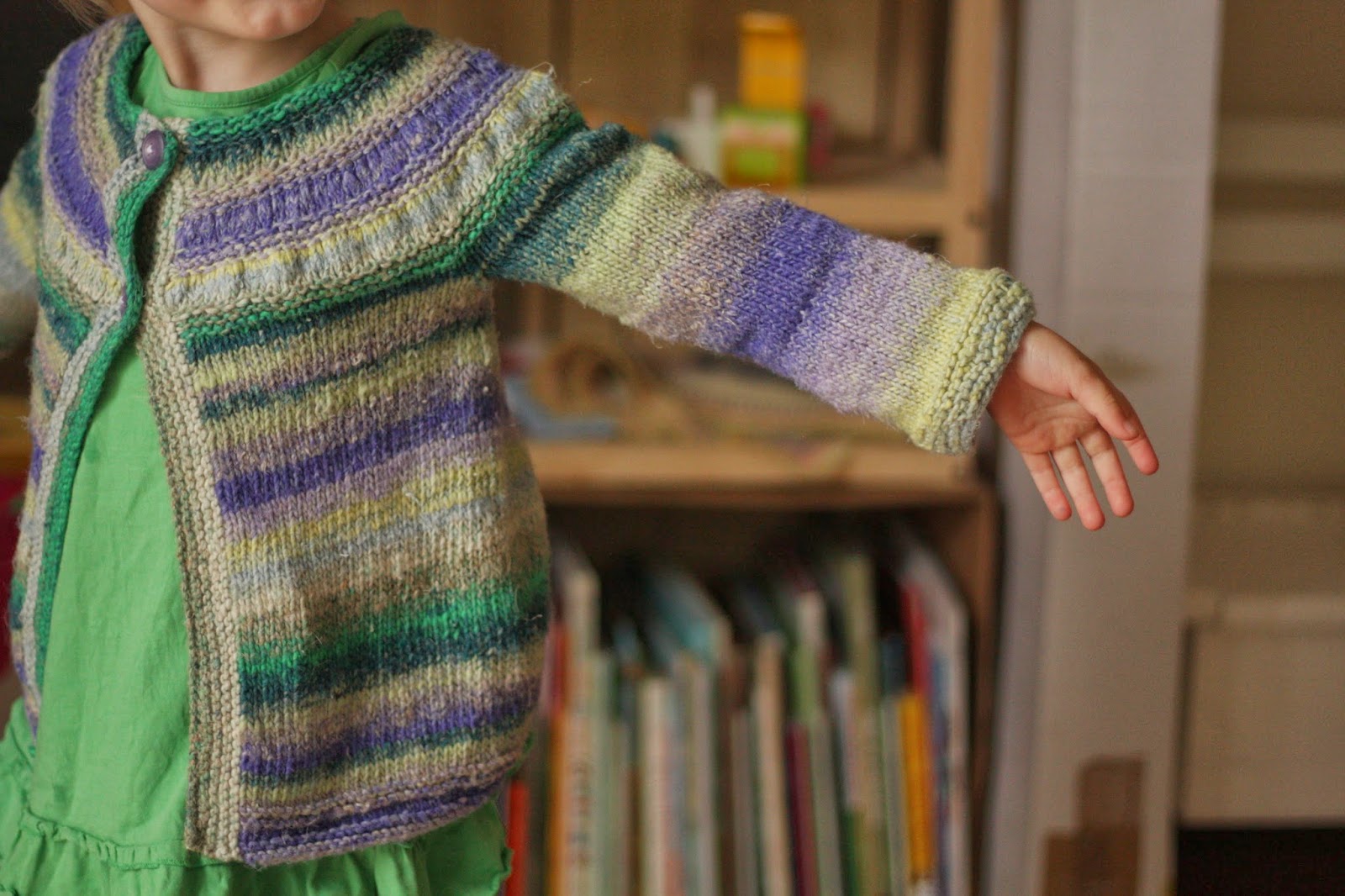
The completed Tiny Tea Leaves Cardi in Noro Aya.

It seems like a day and an age ago since I emigrated to Australia at the end of January. Faced with the prospect of some long-haul flying I was armed to the teeth with a wodge of Noro Aya, a Tiny Tea Leaves cardigan pattern as well as bamboo circular knitting needles to convince airport security that I was not a potential garroter of pilots.


Taaaa daaa! Here's the completed Tiny Tea leaves sported by delighted and (at the time of the photo shoot) industrious recipient the Cherub.


She tells me that she likes the stripes. So that's marvellous news and a bit of a relief after all the effort. At first I was informed that the colours were, in no uncertain terms, "yuk". This is her special and nuanced term of indifference, which usually means I am utterly stuffed and have a snowball's chance in Tahiti of changing the Cherub's mind. Fortunately, the completed ensemble demanded different and careful consideration which resulted in approval.


In all honesty thought, my world has not been set alight. Ok, I agree with the Cherub that the stripes are impressive. But whether it was the yarn - I had my doubts when I started - or the pattern or the combination of pattern with this yarn, I just don't feel this has quite worked. The mixture of silk, cotton and wool in the Aya is rather "rustic" in texture. This in addition to an already heavily textured yoke on the cardigan plus a spectacular spectrum of variegated colour and it's all...


...a bit much. Or maybe each element is a bit lost because of the other elements, none able to stand out and say "LOOK AT ME! AM I NOT BEAUTIFUL AND RUSTIC / TEXTURED / COLOURFUL?!". Hmmm.


In addition the neckline has proved very loose, with the poor Cherub insisting that the cardi is "just perfect" whilst attempting to hoik up drooping neckline over shoulder from where it has been sitting somewhere around an elbow.


But I am a forgiving individual. I'll give the Aya another chance, soon to be incarnated in a crocheted skinny scarf courtesy of a Simply Crochet from May 2013. And next year I'll give the Tea Leaves another crack but in a simple DK. Maybe simplicity should have been my watch word for this project but, hey ho, when you're permanently leaving a beloved country for another it's fair to say one's mind isn't always thinking as clearly as it should.

Cardigan as metaphor for Emigration. Now there's a thought.

(Images: Zoë F. Willis)

Interview with Linda Lencovic of the Kettle Yarn Co.

15 May 2014


Here's a spot of the Kettle Yarn Co.'s Islington fingering - a divine silk and Blue Faced Leicester combo - knitted into the Stones and Stripes shawl designed by Nancy Bush.
Remember the excitement when the spring issue of Pom Pom Quarterly arrived? Remember the thrill of all that Islington fingering from the Kettle Yarn Co. landing in Australia in anticipation of my goodself whipping up the Waterlily pattern on the cover of the aforesaid Pom Pom?

Weeellll, what with other writing ventures, knitting projects, progeny and a tentative yet suprisingly time-consuming dabble as an editor of corporate training manuals (YAAAWWWWNNNNN)...

Waterlily has not quite materialised.

So instead of a blogpost concerning a Waterlily wot I have made (which I am yet to), I present something infinitely more interesting:

An interview with Linda Lencovic, indie yarn dyer, owner of the Kettle Yarn Co. and colourist behind the nuanced hues of the Islington fingering et al. Bless her, bravely answering all my nosy questions about yarn-dyeing.

Linda Lencovic in her own Waterlily (by gum, that lady knits quickly).
Hailing from the wilds of British Columbia in Canada, Linda moved to London in 2006 for an MA in Fine Art at Chelsea College of Art. Apparently the contemporary art scene in Canada was a bit too video-ey and installation-ey.

Not ideal if one wants to paint.

Which Linda did. So she came to London town and enjoyed a successful career as a painter until she shifted her creative focus and established the Kettle Yarn Co. Starting off on Etsy Linda's delicate spectrum of fingering, sport and aran weights has garnered much notice and well deserved comment in the world beyond the intermeweb.  Linda is now popping up at textiley events like Wonderwool and her ridiculously soft skeins are stocked by the reputable likes of Loop and Wild and Woolly.

The Pom Pom effect has probably had something to do with this and judging by the contents of the Summer issue, will continue to do so: Linda's Wimbledon Sport - it comes from super happy merinos - is the yarn for Sarah Hurwitz's tres charmant Creamsicle.

Sarah Hurwitz's Creamsicle in Pom Pom Quarterly, Issue 9, a bobbly delight of a cardigan.  Image © Juju Vail and Pom Pom Quarterly

But enough of the preamble. It's probably about time for that interview. So here it is.

I know that you’ve a background in Fine Arts but what enticed you over to textiles, particularly woolly knittery? 

I have always been interested in textiles and my mother taught me from an early age various ‘craft’ skills such as knitting and sewing. Like most teens I was fascinated with fashion, designing and making garments (very badly) for years. I was always modifying something to make it unique.

At the tender age of nine, I made my first scarf and then stopped knitting. I just didn’t have the patience at that age, but a few years ago I began again after a period of illness a few years ago. I was spending a lot of time in doctor’s waiting rooms and didn’t have the energy to paint  - all the preparation before actually painting is rather labour intensive - so started knitting again to keep creating and making things.

Once I’d picked up the needles, I couldn’t stop! Money was tight so I decided to try my hand at dyeing my own yarn. As an artist I also had the colour theory skills necessary to create the hues I wanted. The step to dyeing for others was an easy one and I discovered that painting yarn was as satisfying – if not more - than painting canvases! There is something hugely rewarding about creating a product that is not only beautiful but hugely useful!

Also creating a garment in the colour I want at the time I want is bliss. I wish I’d rediscovered knitting sooner.

Do you have any family members who have a connection with textiley or woolly pursuits?

Both of my parents are very creative. My mother was born into a large family in the French colony of Reunion. All the children grew up making their own clothes whilst the sisters could also either knit, crochet or make lace. Meanwhile, my father is a classically trained woodworker and I’ve learned many of my artistic skills from both of them.

How did you learn about dyeing yarns?

Mostly trial and error, though I did as much research as possible to avoid recreating the wheel! I just love to play with mixing colours and seeing what happens when I apply them to different bases. There simply is no substitute for hands-on experimentation!

What is kettle dyeing?

The part of the process in which dye is set on the yarn through heating – usually in large pots or kettles – is what is known as kettle dyeing.

Do you use chemical or natural dyes?

I am using acid dye as I still work in my home kitchen. Interestingly, this process is much less toxic than dyeing with natural dyes as the so-called ‘acid’ is just household vinegar. Most people don’t know this - I was fascinated to learn it myself – but the chemicals used to set and create the colours in natural dyeing can be quite toxic and require proper ventilation and a separate working area. It’s not as gentle as people assume when they hear the word ‘natural’!


Skeins. Skeins. Skeins. Luscious skeins of Wimbledon sport.
And just to clarify, you’re dyeing the skeins of yarns rather than the roving?

Yes, I am currently only dyeing yarn as I haven’t tried spinning. I also do not yet know how the colours would spin from the dyed roving. One day I would love to try.

Is sourcing British Wool an important part of your business ethos?

I have carefully sourced British yarns as the environmental impact of my business is a huge concern. I want all of my bases to ensure animal welfare and the lowest carbon footprint possible for the best possible quality of yarn .

Do you choose the yarns’ fibre composition or play with what is available?

It is vital to me that my blends are not only extremely hard wearing and low pilling, but also butter soft on the skin. It’s not an easy task!

This is one reason I am focusing on a lot of British Bluefaced Leicester blends. The long staple fibers making it robust while it’s ‘Superfine’  micron count for the softest fibres – comparable to the softeness of Merino – is perfect for the most sensitive skins.

Do different breeds of sheep have an impact on the dyeing process? 

Absolutely. Even the same breed of wool but from different flocks reacts differently to dye. This is one of the things that makes hand dyeing so unique and every batch slightly different.


A version of the Waterlily in a delicate, sky blue Islington.

You seem to have a really distinctive vocabulary of colour. At first glance the palette seems very subtle and almost demure, but when you look closer there is an incredible depth of tone. What inspires your colour choices?

I have always been very sensitive to colour. I remember at the age of twelve having to find just the exact hue of peach paint for my room. My poor parents learned early on that I had a very distinct sense of style and colour.

I grew up surrounded by the stunning Canadian Boreal forest and am particularly mindful of the natural world. I spend a lot of my time in London’s concrete jungle dreaming of the sea and expanses of green! These hues tend to naturally creep into my colour choices. 

People have been dyeing wool for millennia. How much space is there for innovation?

I think there will always be something new to discover. I am also a firm believer that ‘new’ isn’t always better, and what I hope to focus on is building on the rich history of textile’s past. There is no point in recreating the wheel…but how do you do it your way. As an artist that is a more interesting area of exploration for me.

Any plans for the future?

World domination. 

Many, many thanks to Linda for her time and generosity with this piece. If you want to see what else she is up to then you'd probably best start following her blogging adventures over on From the Purl Side.