Free Cakes For Kids, Hackney

3 August 2014

One of the cakes made by volunteers of FCFK Hackney
 Welcome, welcome to the final part of the Make and Cake Tangent here at TWIHM. So, we’ve looked at the fear and thrill associated with my amateur dabblings for the Cherub’s birthday cake. Next, for contrast, there was a chat with professional pastry chef,Franzi Thomczik, that went off on some interesting historical meanders. There has been Bakewell Tart to accompany proceedings. Now I’m shuffling along to an organisation called Free Cakes for Kids.

Before anyone goes all Daily Mail and huffy (“Oh, the obesity amongst the youth of today exacerbated by the immoral, sugar-plying activities of such groups! ‘Tis the End of Times!!!”) let me note that this is a charitable organisation whose purpose is to make birthday cakes for children who would otherwise not have one.

Pause and think about it for a moment. No birthday cake for a child. That’s a pretty huge thing and a desperately poignant absence for a small person. Or even a big person. Think back to your birthdays as a child; I’m sure many of you have some decent and joyful memories of parties, presents and cakes. Oh, the cakes. Often the ones carefully crafted by mothers, fathers, grandmothers and so forth are the most memorable.

Why so memorable? Particularly those that may have been a bit wobbly about the edges? Homespun, if you will? Probably because the aforementioned familial maker of the cake loved and cared about – and hopefully still does - the birthday child. Also the makers had the time, the kitchen and enough extra money to bake the cake. Seemingly basic elements that many take for granted.

Whereas Free Cakes for Kids helps children who just don’t have some, many or all of those elements that make for a stable family life.

I had a chat with Tessa Lidstone, chum and press officer of FCFK Hackney in London, which provides birthday cakes for some very vulnerable children. Hackney suffers pretty acute levels of poverty. In 2012 Hackney South and Shoreditch came 14th in nationwide a list of child poverty by parliamentary constituency (37% of children) and 20th in the rankings of by local authority (30% of children). If you think I’m indulging in hyperbole here’s that the reference as well as Hackney’s 2013 State of the Borough’s Report on Child Poverty and Family Well-being. The latter states that, although the borough’s child poverty has been decreasing year on year since 2007, it still comes in at number 3 for child poverty amongst all the boroughs of London.

However, as Tessa notes, “It’s not just financial difficulties but also circumstance that mean a child won’t get a cake from their family. For example mothers in domestic violence shelters might not have access to kitchens or just don’t feel up to baking.”

So there are a great number of children in the area who could do with the treat of a birthday cake.

“What works about the organisation is that it is a very simple idea.” says Tessa. “It’s matching up people who love baking with children who don’t have cakes.” Volunteer bakers sign up and offer to bake cakes in their own homes. The FCFK committee receives a request for a cake and then sends out an email to see who is ready, willing and able to do it. Turn around times are pretty quick but then, so it seems, are the responses of volunteers: “[These] email requests get snapped up so quickly that I am sometimes hard pressed to make a cake." laughs Tessa "It’s a common complaint amongst the volunteers. But what’s amazing is that these requests aren’t lingering.”

Members of the FCFK Hackney Committee, with Tessa Lidstone on the far left.
But just how do these requests make it to FCFK, never mind to the volunteers to then result into some pretty smashing looking cakes?

“We advertise ourselves as a confidential service.” says Tessa. What follows are requests and referrals from a number of institutions, groups and individuals such as schools, childcare centres, domestic violence refuges, the Red Cross or social workers.

“Once an organisation has done one referral they find it so easy that they do a lot. We try and find someone who will be the advocate for the family and child, such as a social worker or family support worker.” This advocate is important. Once the cake is made the baker arranges to meet them at a neutral place to hand the cake over. “The baker will very, very rarely come into contact with the child or even the parent. We just make cakes and don’t want to go beyond that with a baker getting involved in a situation or (unintentionally) causing a family to feel in debt. Families don’t want people to know about their situation.” Hence FCFK’s emphasis on confidentiality.

A Peppa Pig-themed confection with young George clutching his dinosaur. Oh, the knowledge I have gained of popular children's culture since becoming a mother. For the non-parents reading this, click on the link. I dare you...
Yet once the cake arrives, be it at school, the childcare centre or even at home “… that child for that day is the special one.” Tessa observes. “It’s not just about the cake but it’s about how much fuss people make of the child. As a child it does matter if everyone ignores your birthday.” It doesn’t take much to imagine what all that lovely fuss and attention does for a child living in otherwise difficult circumstances.

So does the child ever find out who made their birthday cake? Who helped create the fuss?

“It’s up to the advocates and families but I am sure that they do say it’s from this mad group of bakers who like making cakes for people they don’t know!”

Which leads on to the question, what’s the appeal of baking for a stranger? Why not buy a cake from a shop?

“It’s a tangible way of seeing where your donation to your community is going. You know specifically that a child in your area has a birthday cake because of what you have done. It’s not £5 that’s gone to pay for a big charity's admin costs but it is a specific thing.” says Tessa. “Also, those with children know how important it is for the children to have cakes. Other bakers remember cakes that they have had. Some had tough upbringings and didn’t have cakes. [For my family] birthdays were always special occasions and my mum would go all out. It was a home made cake, not a professional one or made at Tesco. The child may be too young to realize the significance but the volunteers do.”

But in this world there’s cake, as in the swiftly cobbled together lemon madeira or muffin variety, and then there CAKE, elaborate and carefully crafted confections that bring extreme pleasure to both makers and recipients. The creations of FCFK Hackney certainly fall into the latter category. But how does the volunteer find out what themes, colours or flavours a child likes?

A rainbow cake with an ingenious construction of cumulus clouds from marshmallows. Who wouldn't be happy with that?
Hooray for the referral form: “In it there’s a question about what the child likes.” Sponge or chocolate cake are the standard base with lashings of butter cream whipped into some sort of fantastical marvelousness inspired by themes. “That could be a favorite colour. Parents’ will note the child’s preferences, maybe ask for birthday numbers or the child’s name. Princesses or ‘something girly’ are recurring themes. But our bakers are not creatively restricted. We are lucky that some of our bakers go all out so they love working with the theme and they like a challenge. It grabs our baker’s imaginations.”

So there’s a creative outlet for the bakers and the chance to develop some skills with every baking challenge. FCFK Hackney also offer the volunteers a baking master class just before Christmas as a chance to enhance their talents. But there’s also a bit more to it, as Tessa explains “We do the master classes as it can get quite lonely being part of an organisation where you don’t meet so many people. You get an email, make a cake, drop it off. We do social events so bakers can meet other bakers and learn the reasons why other people are involved.”

Volunteers at the FCFK Hackney's Christmas baking masterclass.
It’s not just the bakers themselves benefiting from such classes. FCFK Hackney started arranging baking workshops with some of the referring organisations, creating opportunities for parents, children and referrers to all make and bake together.

There isn’t a formal feedback process from cake recipients to cake bakers. Yet it’s in heartwarming spaces like the workshops, spaces where communities gather to enjoy together the simple act of making, that FCFK Hackney are told just how much their cakes are appreciated.

One of FCFK Hackney's baking workshops held in the community.
It’s a special thing this whole making and baking malarkey. I can see a PhD needs writing about the power of buttercream as a social bond. As I’ve noted before, ephemeral as these cakes may be, the sheer pleasure the bakers find in making them and the joy the recipients have in receiving them is the stuff of which memories and strong communities are made.

And in these difficult times we need as much of that pleasure, joy and hope as we can get.

I think the smiles in this picture sum it all up, don't you?
(Images: FCFK Hackney)

The Bakewell Tart Recipe by Franzi Thomczik of the E5 Bakehouse

4 July 2014


Cake and Crochet. An alliterative juxtaposition emphasising how flippin' fantastic it is to make a couple of granny squares whilst enjoying a Bakewell Tart. Multitasking at its best.

After all that talk of cake with pastry chef Franzi Thomczik of the E5 Bakehouse, it was only good, proper and right that there be some sort of complementary recipe. Thankfully, Franzi came up trumps and offered a titan of the afternoon tea scene. Cue….


A perfect amalgam of tradition, jam and almondy lusciousness in tart form. Small wonder this is a favourite amongst the pastry selection at the E5 Bakehouse.

The cleverness of this recipe lies in its construction of various good things that can be used in their own right (raspberry jam) or form the basis for other sweet delights (shortcrust pastry and frangipane). In addition, you can prepare each element at different stages and bring them altogether in their Bakewell Tart magnificence at a time that suits you.

Clearly this recipe has its origins a moment of culinary panic, when the in-laws were visiting at relatively short notice. They needed to be impressed and shortcrust pastry, frangipane and jam were the only ingredients one had to hand.

Hopefully, you’ll be a bit better organised than the mythical first maker of the Bakewell Tart. Franzi’s recipe is enough for 17 small tarts plus a few lemon butter biscuity things. A delightful bonus.

Raspberry Jam

  • 500g fresh or frozen Raspberries
  • 250g caster sugar
  • 2 tablespoons lemon juice

Pile up the sugar and raspberries in a preserving pan or large saucepan. Don’t forget to add the lemon juice! That would be disastrous.

Place on a gentle heat and keep at a simmer – stirring occasionally - until the fruit has softened and all the sugar has dissolved.

Once everything is squishy and there’s nary a hint of sugar bring it to the boiling point and boil rapidly. Keep this up for 10 to 15 minutes or until you reach the setting point.*

 Take the pan off the stovetop and give the jam a chance to settle for a few minutes. Decant into hot, sterilized jars (TIP: place a metal tea spoon in the jar before you put the hot jam in to prevent the glass from breaking) then seal.

The jam will keep for 6 months.

Alternatively you could use 700g of a good quality, shop-bought jam. And sotto voce it doesn’t necessarily need to be raspberry.  Just make sure it’s a flippin’ awesome jam. You wouldn’t want to undermine all that hard work on the shortcrust pastry and frangipane with underwhelming jam. That would be a travesty of minor proportions.


Piping the jam into the shortcrust pastry but for the sake of washing up the piping bag more than once, a tablespoon will do the job at this juncture.

 Shortcrust pastry

  • 250g butter
  • 375g flour
  • 1/2 tsp salt
  • 110g icing sugar
  • 1 medium egg
  • zest of 1 lemon
Put all ingredients - except the egg-  in a bowl and rub between your fingertips until a crumbly texture forms. Beat the egg then add it to the crumbs and work through until a dough forms. Once it comes together stop working it, otherwise it will become tough rather than light and crumbly after baking.

Wrap it in cling film and chill in the fridge for at least an hour. This will make enough pastry for the base of 17 tarts plus extra left over with which you could make some simple lemon butter biscuits. My, how the in-laws will be thrilled…

Frangipane

  • 150g butter, softened
  • 150g caster sugar
  • 150g ground almonds
  • 3 medium eggs
  • 45g sifted flour
  • 1/2 tsp vanilla extract
  • 30g rum
  • pinch of salt
Beat the butter, sugar, vanilla and salt together until pale and fluffy on medium speed. If you are using a Kenwood or Kitchenaid, use the paddle attachment.

In a separate bowl beat the eggs with a whisk and gradually add the eggs whilst the mixer is still running. Scrape down the bowl in between additions and make sure the eggs are well incorporated into the butter at each stage (this helps prevent the batter from splitting).

Add the flour and almonds, mixing minimally, and finally the rum.

Allow the mix to rest in the fridge for 30m before using and then bring out and leave for another 30 minutes before piping. It can be a bit stiff to force through the piping bag otherwise.

The frangipane can be kept for up to a week in a sealed container in the fridge. 

Franzi piping the frangipane atop the jam.
 To construct the Bakewell Tarts

Preheat the oven to 170˚c.

Roll out the shortcrust pastry on a floured surface until it is about 2.5mm thick. Cut out circles using an 88 mm pastry cutter. Remember, you’ll have a bit more pastry than for 17 tarts so use the rest for some elegant biscuits.

Place the circles in muffin trays and fill each pastry cup with 1 tablespoon of jam. Pipe each tart with frangipane and sprinkle the flaked almonds on top.

Bake for 25 minutes, turning half way.

Allow to cool before removing from the muffin tray.

To accompany tea, company and – for a true appreciation of the Bakewell’s ambrosial properties – knitting.

Enjoy.


*WAIT! What’s the “Setting Point"?

This is the moment when the jam is ready to go into jars. You can check this moment by one of two ways. First is with a sugar thermometer, clipped onto the side of the pan. The bottom end must not touch the pan’s bottom otherwise you’ll get a dodgy temperature reading. Not what you want. When the jam is in the throes of a rolling boil, the thermometer will register 105˚c. The second, old-school Nana way to check is (appropriately) called the “wrinkle test”. Put two teaspoons of jam onto a cold saucer. Leave it alone to cool off for a couple of minutes. Then gently push the jam with a finger. If it wrinkles, setting point is reached, you’re done.

(Images: Zoë F. Willis, E5 Bakehouse)

Interview with Franzi Thomczik, Pastry Chef of the E5 Bakehouse

27 June 2014


Franzi Thomczik, pastry chef of the E5 Bakehouse
  
I’m continuing along the Make and Cake Tangent here at TWIHM. After recent efforts or “dabblings” with sugar craft for the Cherub’s birthday, we are moving up a notch or two; an interview with a bona fide pastry chef. Franzi Thomczik is creator of cakes at the E5 Bakehouse in Hackney, an establishment famed for its sourdough bread but also a purveyor of cinnamon buns, opera cakes and salted caramel & chocolate tarts beyond compare. Even Nigella has sent her blessings from Twitter heaven upon the latter. And the day I had the chance to be a guinea pig for a prototype, inhouse version of the Tea Cake – Oh, the dark chocolate. Oh, the mallow. Oh! The berry jam! - will go down in my personal history as a Significant Life Moment. 


Cinnamon buns. A little known but very effective cure for writer's block.
Franzi hails from Berlin where she trained as a Konditor. This is somewhat more than a mere baker of cakes. The emphasis for a Konditor is on cakes’ decoration and artistic presentation. We’re talking about a profession with a fair wodge of history behind it. The trade’s origins kick off around the 12th century with the introduction of sugar from the Middle East, exciting, moldable and edible stuff like marzipan (thank you Medieval Venetians for both of those) and candied fruit for sweet breads. Oh, and it seems convents, abbeys and other religious institutions played an important part in the development of decorative, cakey deliciousness to coincide with religious feast days. There was a big emphasis on almonds and honey in various forms of tart. 

For those who fancy practicing their rusty German, there's a potted history on the German Konditor Guild's (Yes! They have a guild and have done since the 16th century) website, here.

Right, dragging myself from the fascinating medieval history – be still, my beating heart – back to a very contemporary London where Franzi moved to. There she worked at Peggy Porschen, the bespoke and very chic cake maker in Belgravia, where she learnt many an additional whizzy thing about decoration and sugar craft. However, a bread internship at the E5 Bakehouse resulted in a job offer and Franzi headed East, away from society wedding cakes to create her own pastry section. Franzi very generously sat down with me and we had a marvellous chat about cakes, baking and a few tips of the trade.

Cake. That is all.
At first Franzi’s move East was an interesting one. “It took time to get established here at the Bakehouse. The tastes are so different here to West London.” But by observing customers, responding to their requests and excitement about new cakes Franzi soon had a very strong pastry selection. Support and creativity also flowed from her colleagues, both bread bakers and other pastry chefs who later joined the Bakehouse. “There are so many people from all over the world here at the Bakehouse; the variety is fantastic. I could travel the world but everyone’s ideas are all together here.”

Ah, there’s that theme again of international networks influencing cakes. Curiously, these influences are sometimes unknown to keen consumers of cake. Brownies and lemon meringue pie are amongst the most popular requests but so part of the baking mainstream have these imports - hailing in their current form from America -  become that they are considered English classics. In fact, “you tend to get a lot of muscovado and treacle in classic British cakes, more nutmeg, ginger and cardammon. It’s spicier here than in Germany where we use much more cinnamon and cloves”.

On another sweeping historical tangent here I wonder if EMPIRE might have something to do with the distinctive flavours of British versus German cakes. All that muscovado and treacle hailed from the Caribbean sugar plantations (British). Meanwhile nutmeg, ginger and cardamom came from – respectively – Indonesia (granted, this was a Dutch territory but the British had Malaysia. Close enough), South China before cultivated in West Africa and the Caribbean (British trade connections with the former and colonies in the latter two) and India (East India Company, anyone?). However, Germany was an uncomfortable mélange of independent kingdoms, dukedoms, princedoms before concentrating on becoming a united German Federation during the 19th century. There’s not too much time for empire-building and exotic spice cultivation in those sort of circumstances.

Hence cloves in German baking. Cinammon. And butter. And cream. And other delicious ingredients that are traditional.

It’s fascinating how themes like tradition and nostalgia do play a significant role in cakes. “Yes”, says Franzi “It’s often what drives customers’ requests. I have free rein to try new things at the Bakehouse but you can’t reinvent everything. There is a reason you have classic cakes, like the Eccles cake. It’s great to keep these traditional things more traditional”.

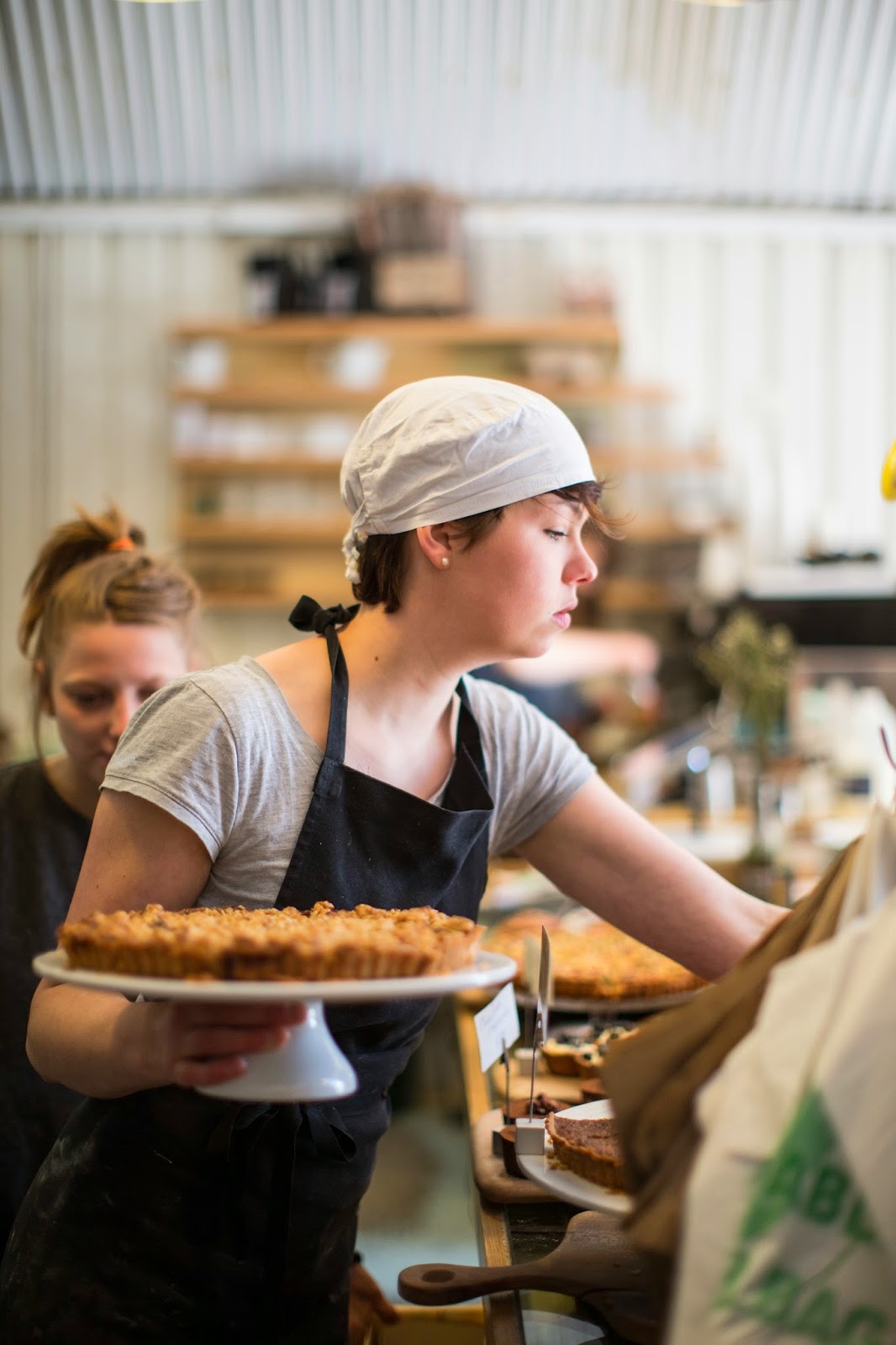
Franzi replenishing the pastry selection. This is always a happy moment for customers.
These traditional recipes were often created in response to the seasonality of ingredients. Seasonality, sustainability and local provenance are key elements of the E5 Bakehouse’s ethos so it’s all rather complementary. Once Franzi sees what’s available from suppliers, she can plan and experiment with her pending pastry selection. In essence, “summer is a time for refreshing flavours whilst winter is the chocolate and nutty season with quite a bit of dried fruit.” Spring is tough though: “People have had too much rhubarb and are over apples and pears!”

Ingredients have an important impact on the freshness and longevity of a cake. The more butter and sugar in a recipe – essentially many 'wintery' cakes like brownies, pecan pie, ginger cake – the longer it needs to sit. The flavour needs to develop.

However, “you must eat anything with fruit as soon as possible and the same goes for cheese cake.” French patissier-style cakes also fall into this category. “Choux pastry needs to be eaten quickly as it soaks up all the moisture from the cream”.

So there are some useful eating tips – always gratefully received – but what about making tips? Could a mere mortal with lashings of enthusiasm rather than years of professional training attempt a few tricks of the trade? Of course we can. Franzi notes that “silicon molds are really useful for making beautiful structures out of mousses and creams. The molds are also great for freezing and baking.” If you are trying some fruitier numbers “boil up some apricot with a bit of water and then strain it. Use it to paint the fruit and give them a glaze”. For those of the waste-not-want-not school of thought, “boil up apple peel and cores in water with caster sugar for an hour. Strain it and leave it cool. Heat it up again. The high pectin means you can use it to glaze cakes like Hot Cross Buns.”

But amongst the seemingly infinite panoply of cakes available to Franzi, which are her favourite? “To make, it’s the Opera Cake. It’s an elaborate one with butter cream and a lovely joconde all in layers. I love making mousses and choux pastry as they create the challenge of timing and precision. It’s the satisfaction of making something, knowing it’s not something everyone can do.”

Preparing brownies. Who gets to lick the bowl? Actually, is that even allowed?!

It’s a funny old thing that craft and cake tend to go hand in hand. Making things in a group as well as eating things in a group are important glues that bind families, friends, generations and communities together. The interesting contrast is that there is so much passion, creativity and excitement in both say, knitting and baking a cake, yet you’re left with a tangible relic from crafting. For years you could end up wearing the jumper you made. I mean, archaeologists recently found two pairs of 3,000 year-old woolen trousers

There’s longevity for you.

By contrast there is an ephemerality to baking, beautiful and delicious constructions that bring so much pleasure to the moment but are soon gone. Oddly though, it’s those ephemeral experiences that can be the most intense in our memories (Exhibit A: Indecent Tea Cake Prototype). A whiff of cinnamon or the taste of Crème Chantilly can transport you back to a past event or place with a rich immediacy that is breathtaking.

But it’s the process of making in both crafting and baking that bring so much pleasure and creative joy. 

And imagine having the privilege of making and enjoying that creativity every day. To my mind, Franzi falls into the same category as freelance knitters, indie yarn dyers and knitwear designers. They all have that privilege. To quote Franzi, “I’ve got the dream job. I am an absolute cake addict and when not at work, I enjoy eating cake. I pretend it’s for professional reasons but really, it’s because I love cake”.

Happiness is... a day job doing what you love. Bonus if that involves making cake.
With many thanks to Franzi for her time and generosity with this interview.

(Images: E5 Bakehouse)